STC 49
Sound Transmission Class of 49, measured by the CSIRO in 1995 (Report HAS 112, AS 1276–1979 procedure) — above the STC 45 then required by the Building Code of Australia, and approved on this basis in the ACT in 1996.
CORCON slabs have been independently tested: cyclic seismic loading at the University of Melbourne, and acoustic and fire testing by the CSIRO.
Year the system was approved in the ACT, on the strength of its STC result
Sound Transmission Class, CSIRO 1995 — above the STC 45 then required by the Building Code of Australia
Fire rating, based on a CSIRO fire test to AS 1530.4–1997
Performed to 110 minutes in independent CSIRO fire testing
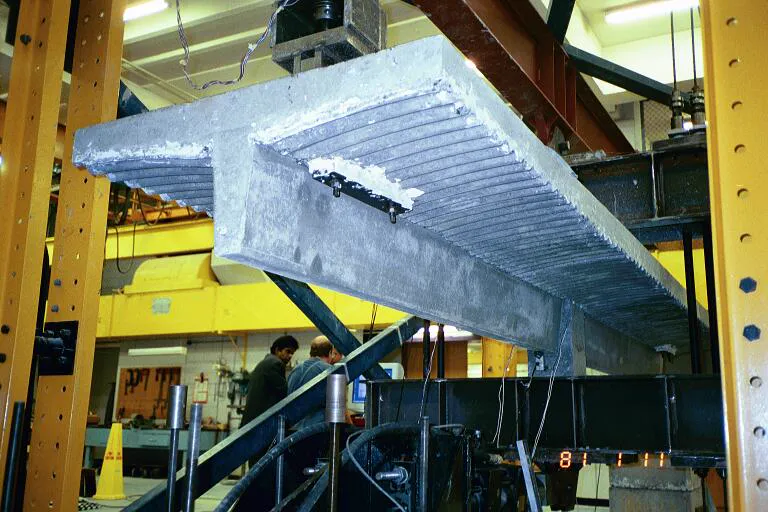
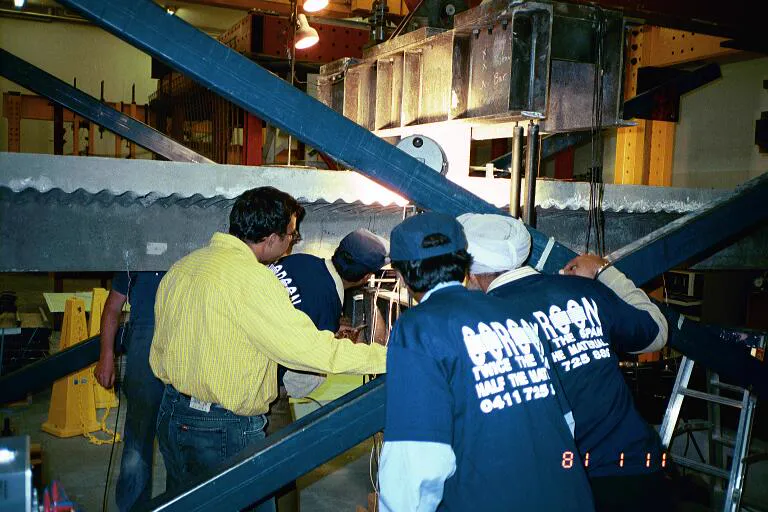
Seismic research at the University of Melbourne tested a half-scale CORCON beam-slab-column joint under cyclic load in the university’s structures laboratory — the test behind the 4% drift-ratio result.
The specimen was detailed to the Australian codes of the time (AS 3600–2001 and AS 1170.4–1993) with no special provision for earthquakes. Once the reinforcement detailing was corrected, it showed no overall loss of strength up to 4% drift. The result is set out in full in a peer-supervised engineering thesis.
The research also documents a university-verified repair pathway using CFRP retrofit for damaged structures — so a CORCON slab that has been stressed by an event has a defined route back to service.
Both results come from CSIRO tests, which is why slabs for fire- and acoustic-rated use are cast 85–100 mm thick.
Sound Transmission Class of 49, measured by the CSIRO in 1995 (Report HAS 112, AS 1276–1979 procedure) — above the STC 45 then required by the Building Code of Australia, and approved on this basis in the ACT in 1996.
Designed to a 1.5-hour fire rating, based on a CSIRO fire test to AS 1530.4–1997 (Report FSH 0684, 1999). In that testing the slab performed to 110 minutes — relevant where fire compounds earthquake damage in dense urban rebuilding.
CSIRO measures a Sound Transmission Class of 49 (Report HAS 112).
The system is approved in the ACT on the strength of the STC result.
CSIRO fire test to AS 1530.4–1997 (Report FSH 0684) supports a 1.5-hour fire rating.
Half-scale beam-slab-column joint tested under cyclic load at the University of Melbourne.
| Test | Body | Standard / basis | Result | Reference |
|---|---|---|---|---|
| Seismic — cyclic load | University of Melbourne | Detailed to AS 3600–2001 and AS 1170.4–1993, with no special provision for earthquakes | No overall loss of strength up to 4% drift (4.0% drift ratio sustained) once the reinforcement detailing was corrected | 2002–03 |
| Acoustic | CSIRO | AS 1276–1979 procedure | STC 49 — above the STC 45 then required by the BCA; approved in the ACT in 1996 | Report HAS 112, 1995 |
| Fire | CSIRO | AS 1530.4–1997 | Designed to a 1.5-hour fire rating; performed to 110 minutes in testing | Report FSH 0684, 1999 |
The full University of Melbourne test report and the CSIRO acoustic and fire data are walked through in a technical briefing.