Decoin Pty Ltd, established in 1978 in the Australian Capital Territory, developed CORCON and remains the founding engineering practice behind it. The system is now supplied worldwide by Design Construct Industries, led by CORCON’s inventor, Andy Stodulka.
Corporate history
An independent Australian structural engineering practice, since 1978.
Decoin Pty Ltd is an independent firm of structural consulting engineers, designers and contractors, undertaking structural design, documentation, architectural planning, specification and construction — from cost-effective design solutions through to commercial construction. Decoin developed CORCON and was originally responsible for its manufacture and worldwide distribution. CORCON has since won 10 national engineering and industry awards, been patented across 17 countries and regions, and been independently tested by CSIRO, the University of Melbourne and the China Academy of Building Research — full certificates on Awards & Patents.
EST. 1978
Decoin Pty Ltd
The founding practice. An independent firm of structural consulting engineers, designers and contractors based in the ACT, responsible for developing CORCON and, historically, its manufacture and worldwide distribution.
TODAY
Design Construct Industries (DCI)
CORCON is now supplied by DCI, led by the system’s inventor, Andy Stodulka — carrying forward the engineering and commercial relationships built up over decades of deployment worldwide.
CHINA
Beijing International CORCON Formwork Pty Ltd
Represents the CORCON system in China, building on the CORCON–China Academy of Building Research joint venture and the formal load testing carried out in Beijing.
20%Cost saving reported by IJM across two five-storey car parks, Malaysia
30%Construction time reduction reported on the same IJM car park projects
20,000+ m²Suspended CORCON slab placed in the ACT since production began
$80/m²Savings reported by one Darwin contractor using the formwork
Figures as reported by clients and contractors in Corcon corporate correspondence, not independently audited by a third party — distinct from the university- and CSIRO-verified testing referenced elsewhere on this site.
Our people
Engineering leadership.
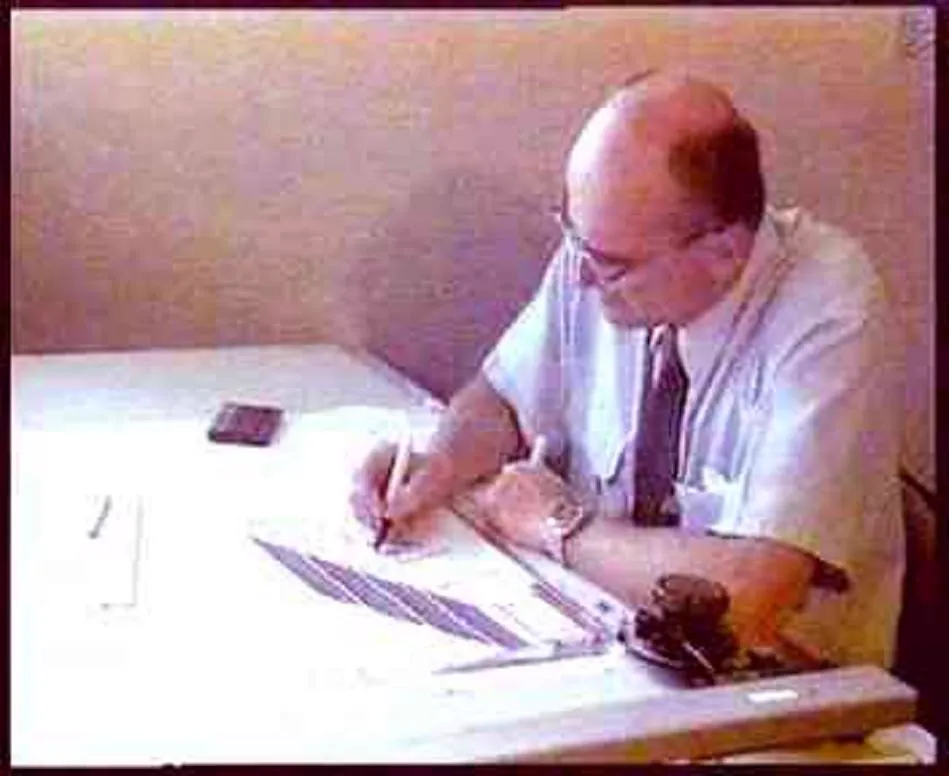
Andy Stodulka, inventor of CORCON.
Andrea (Andy) Stodulka — Director & Principal Engineer
B.E. (Hons), M.Eng.Sc., M.I.E.Aust.
Andy Stodulka is the inventor of CORCON. He graduated from the University of Sydney with Honours in Soil Mechanics and Hydraulics in 1971, then completed a Master’s degree in Hydraulic Structures. His early career included the Australian Construction Services and, as a CBI Scholar in the United Kingdom, spells at Balfour Beatty and Sir William Halcrow. After a period in the Australian Department of Productivity, he formed Decoin Pty Ltd in 1978 to specialise in structural design and construction.
He has lectured in engineering at the University of Canberra and Canberra TAFE, supervised large construction projects across Canberra, and holds an “A” Class Builder’s Licence in addition to being licensed as a structural engineer throughout Australia. He has personally supervised and trained CORCON installation teams on site, including on the first CORCON project in Qingdao, China.
B.E. (Hons), M.Eng.Sc., M.I.E.Aust.
University of Sydney, 1971
“A” Class Builder’s Licence
Licensed structural engineer, Australia
50+ years engineering practice
Chief engineer
Pierre Dragh
Pierre graduated with Honours in Structural Engineering from the Academy of Engineers, Lyngby, Denmark, in 1993. His research in France on negative skin friction on piles included the first such experiments ever carried out in a centrifuge. At Decoin he has been closely involved in the design of CORCON — analysing test results and preparing the calculations behind the CORCON span tables.
Built with industry
Trialled with real contractors, not in isolation
CORCON’s components were refined with contractors willing to trial a new product and give direct feedback on site — faster and more practical for a small firm than internal testing alone. With thanks to Taras Teodorowych (Truform, Queanbeyan), John Gracik (Lavi Engineering, Queanbeyan), Julio Garcia Formwork (Queanbeyan), Doug (Oztin, ACT) and Anthony Parsons (Newcastle).
Our story
Decades of testing stand behind the finished system.
CORCON was patented across 17 countries and regions worldwide — the product of an iterative design process refined over decades, not a single prototype.
01
Plan, calculate, redesign, check — a continuous quality-control cycle applied to every prototype under real budget constraints, minimising dead ends.
02
Full-scale destructive testing using an improvised rig: a sandwich of 700 mm deep I-beams and a PVC cushion of water pressurised with a standpipe.
03
Field trials with independent contractors across Queanbeyan, the ACT and Newcastle, generating direct site feedback a small firm could not have produced through internal testing alone.
04
$2 million committed to a dedicated rollformer , lifting production from roughly 1,000 m a month on a sheet folder to 1,000 m a day.
The result balances low weight for easy handling and installation with enough strength to maximise the distance between props, while using standard BHP steel sections and existing fabrication processes rather than exotic materials.
CORCON is intended to deliver savings to client, developer, contractor and subcontractor alike, while displacing rainforest plywood formwork with a reusable steel system — reducing concrete and steel reinforcement use and the embodied energy that comes with them.
1B+ m²Estimated annual Asian market for suspended concrete floor systems
200,000tSteel saved per 1% of that market captured by CORCON
1M m³Concrete saved per 1% market share
200,000 m³Rainforest plywood saved per 1% market share
These are Corcon’s own market-opportunity estimates, not independently audited figures. What is independently documented is deployment: CORCON has been used in Malaysia, the Philippines and China. In China, engineers were at first reluctant to take full advantage of the system’s material savings, because it was new and had not been formally tested there — the CORCON–CABR joint venture and the 2005 Beijing load tests were undertaken to obtain that formal endorsement.